
Welcome to Philadelphia Bird Control: Prevention and Removal of Unwanted Birds
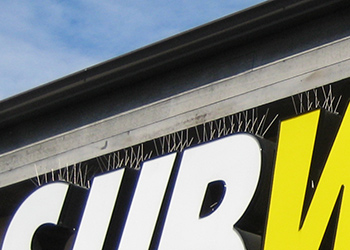
Our company specializes in resolving problems caused by birds in Philadelphia, Pennsylvania, both residential and commerical. We handle bird species such as pigeons, starlings, grackles, sparros, and even Canada Geese and woodpeckers. We generally don't kill birds - we prevent them from causing problems. Most commonly, this means that we install barriers that prevent them access to your building or property, or anti-roosting devices that prevent them from landing, nesting, or roosting on your home, store, building, or anywhere. We use netting, needle strips, shock track, and more. We do offer trapping in some cases, and removal of birds from warehouses, grocery stores, or other commerical or industrial buildings by netting or sometimes pellet shooting. We have a wide variety of tools and methods for solving every manner of bird problem. Call us at 267-817-9892 to discuss your bird problem today.Our Work
Full Range of Bird Control Services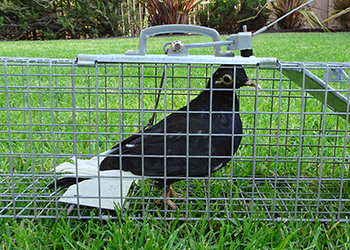

More About Us Philadelphia Bird Control:
Since our founding day, our people have worked hard to help commercial establishments and homeowners from their bird invasion problems. Our ten years of doing business have provided us with invaluable knowledge and experience that have made us one of the most reputable and trusted bird removal companies in the state. If you want to evict these unwanted visitors from your house, believe that our people will always deliver. During your initial consultation, we will make sure to listen attentively to your words. We will get to know your every need and concern. It will help us provide a personalized approach to our bird management service. We will then evaluate your problem by performing an on-site inspection. With this, we will be able to determine the root cause of the problem, the level of your bird infestation, and the extent of the damage. It will give us the capacity to offer a tailor-made solution that will consider the cycle, biology, and habit of these birds. Once you agree to our proposed strategy, we will now be ready to implement the solution using the most efficient, safest, and humane approach. We will make sure that the birds will not be returning in the next season. Preventing future bird problems is the mission of our company. We offer a periodic treatment and prevention plan that will check your site for any vulnerabilities.Biology of Pigeons
Appearance
The pigeon is one of the most commonly found birds in urban areas, with there being many species of pigeon, some as large as a turkey like the Crowned Pigeon of New Guinea, to others as small as a sparrow-like the New World ground dove. They tend to have short legs and small bills, with small heads on large, compact bodies. They vary greatly in color from species to species, with colors like white, yellow, brown, green, blue and red decorating their feathers, but the most common species is colored grey with black bands on its wings and tail, and a green hue on its neck.
Biology
It's hard to tell male and female pigeons apart since they do not exhibit significant color differences like peacocks or sparrows. There is a slight difference in their behaviors and the shape of their bodies (males are more energetic and have thicker necks and a more robust build), but using these differences to tell them apart is an unreliable method.
Nevertheless, pigeons mate for life (with mating taking place at any time of the year), and both parents actively take care of the young. The female lays 1-3 eggs at a time about nine weeks after mating, while the male guards the female and the eggs. When the young hatch, both parents feed them "pigeon milk," a semi-liquid substance produced in an adult pigeon's crop.
Lifecycle
After a baby pigeon is born, it stays in the care of its parents for only 4 to 6 weeks (during which the mother may lay another clutch of eggs), after which it leaves the nest to live on its own. Pigeons reach sexual maturity close to 7 months of age, after which they choose a mate for the rest of their life. Not the best homemakers, pigeons construct flimsy nests wherever they find space, where the female decides to lay its eggs. Pigeons may live up to 15 years in captivity, but the harsh environment and dangers of the wild often result in them living up to a shorter age.
Habitat
Unlike other birds, pigeons are one species that have benefitted from human activities, which is why they're present in such large numbers in cities and rural areas all over the world. They make their homes in any human-made structures they find space in, be they in buildings or on top of bridges.
Diet
Almost all species of pigeons have a diet consisting of seeds and fruits, with most of them only preferring one of the two. A small subset of the pigeon species, however, prefers to hunt for worms and insects for its primary food supply.
Behavior
Pigeons are normally docile birds, which has allowed people to keep them as pets for generations. They can also be trained to carry messages over long distances, as they have over the course of history. Pigeons are known to constantly bob their heads, which appears comical, but is an effort by the pigeon to keep its vision constant.
Also read our other bird tip: How Did A Dead Pigeon In Attic Get There?
We have the most experience in Philadelphia at understanding the nuisance birds of Pennsylvania. Our 7 years of experience in the field ensures excellent results.
We pride ourselves on the quality of our bird control work. Our work is professional grade and long lasting, usually for the life of the building.
We are fully Pennsylvania licensed. We carry the correct safety equipment, and operate in a safe and professional manner to keep your building and people safe.
Call us at 267-817-9892 to discuss your bird problem and our process. We are always responsive by phone. We can usually schedule next-day appointments, and provide written estimates for all our bird work.
Thank you Philadelphia Bird Control for keeping the pigeons off of my storefront. My sidewalks are clean now!
These guys were the only ones who could get a sparrow out of my clothing store. Thank you!
Your goose abatement program has kept my golf course dropping-free. I recommend Philadelphia Bird Control.